Regional school Neukloster
Kugelgarn® for a school building with atmosphere

| Owner: | City of Neukloster, D-Neukloster |
| Architecture: | Roland Schulz, D-Schwerin |
| Carpet fitter: | Raumausstatter Günter Helms, D-Pampow |
| Flooring: | Kugelgarn Impression® malawi 247 |
| Delivery form: | Broadloom |
| Total area: | 2500 m2 |
| Photographer: | Jochen Stüber |
School building with atmosphere
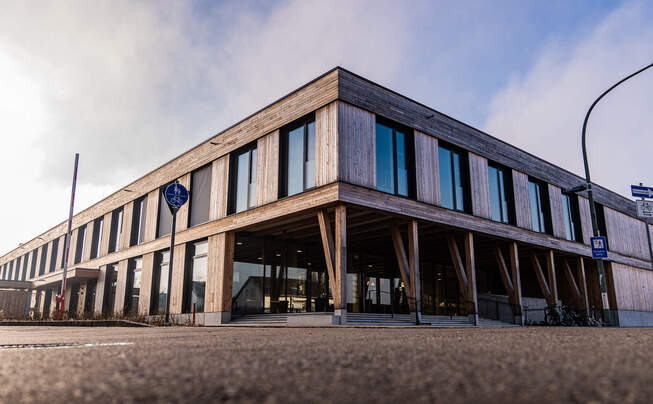
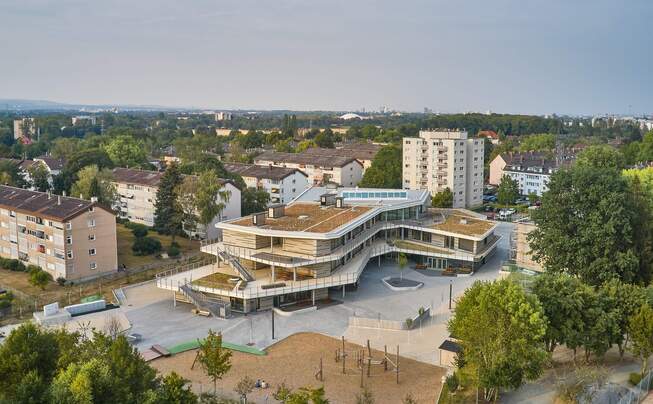
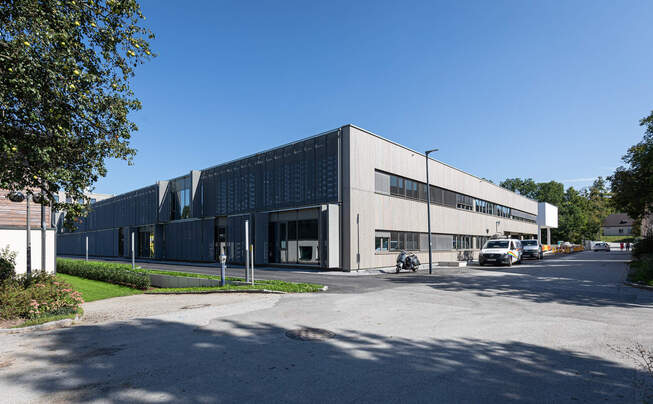
The extension to the regional school in Neukloster has created a space that is not only functional but also has a great atmosphere. Clean architectural lines, a well-thought-out choice of materials and the interplay of colours and surfaces create spaces where pupils can feel at home.
We spoke to architect Roland Schulz about his central ideas for the spatial concept, the special combination of materials and the advantages of textile coverings in school construction.
Fabromont: What were the key considerations that determined your spatial concept for the new extension?
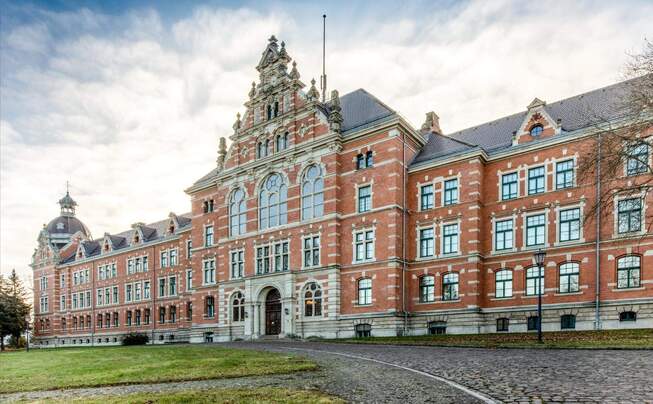
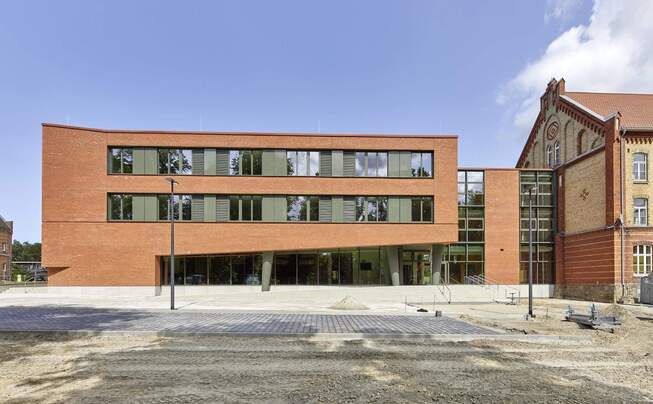
Roland Schulz: I developed the spatial concept based on the extension of the central corridor axis of the historic school building from 1874, with classrooms arranged in the classic manner on both sides on three levels.
In contrast to this arrangement, however, I wanted to create a central space at the end of the corridor extensions, around which all other functional areas are arranged. A prerequisite for this building concept was to place the new extension building via a glass connecting structure as a transitional element in line with the main façade of the listed building. After tough negotiations with the monument preservation authorities, who would have preferred to see the new building hidden behind the historic monument, a compromise was reached whereby the façade of the new building was redesigned with water-struck bricks. The design elements of the existing building, the base zone and eaves, as well as the floor heights, were the key elements of the design for the exterior appearance from the outset, as was the auditorium for the internal structure of the new extension's spatial concept.
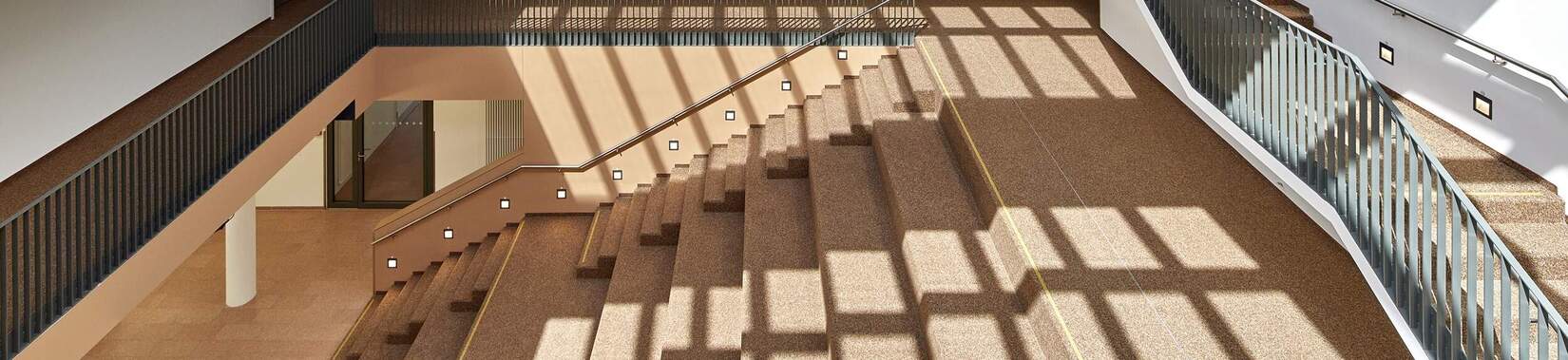
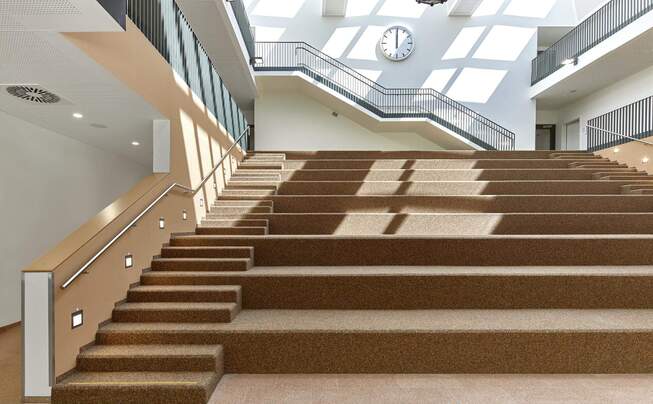
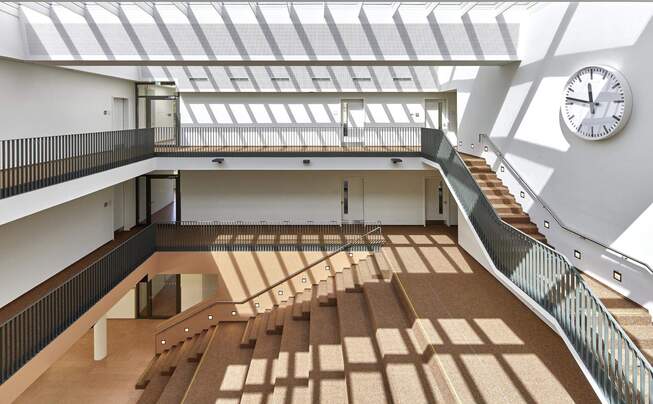
The defining spatial elements of the auditorium are the seating steps connecting the ground floor with the first floor and the three large glass skylights in the auditorium roof.
After the first two weeks of school, we have already noticed that this space, similar to a market square, has been very well received and is being used by everyone as a meeting place. We have further expanded the range of uses here with a student café in front of the glass façade facing the schoolyard. During breaks, even when the weather is nice, none of the 40 chairs are left empty.
Fabromont: How did you arrive at your choice of materials, especially the combination of Kugelgarn Impression® malawi textile flooring with Italian terrazzo?
Roland Schulz: When Jan Färber, the Fabromont area sales manager responsible for us, came to the office in 2018 with the then new Impression® collection – inspired by nature photographs – we had just started the school construction project in Neukloster.
The Malawi colour pattern in this collection particularly caught my eye. With its striking mix of dark earth tones accentuated by reddish-orange colour balls, it was a perfect match for a terracotta-coloured concrete block that we had already used several times in entrance halls and stairwells. This, in turn, consists of an interesting composition of iron oxide mixed with various types of marble, including red Veronese marble, Rosso di Verona, from a local Italian manufacturer.
We then supplemented the material concept for the flooring samples with a rubber covering in a colour matching the Kugelgarn Impression® malawi and the terracotta-coloured concrete slabs for the wet sanitary areas and some specialist classrooms.
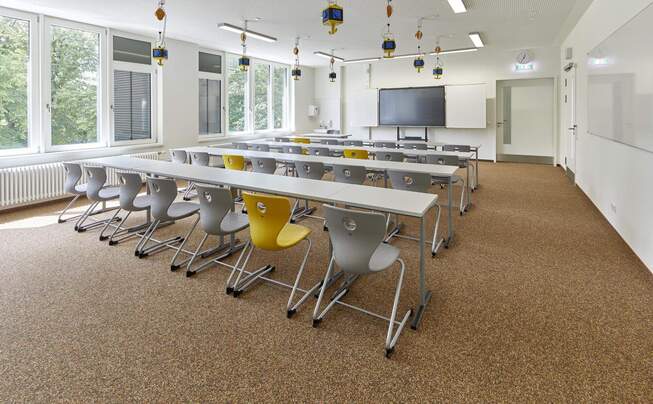
This enabled us to convince the building authority of the town of Neukloster, as the school authority, to approve the installation of Kugelgarn® in all other areas, including the classrooms and the corridors on the two upper floors.
Fabromont: How does the textile flooring change the perception of the pupils in the classrooms, but also in the assembly hall with its large staircase?
Roland Schulz: After the first two weeks of school, the headmaster told me that the move to the new extension had changed the children. They were moving around more considerately and the floor covering was also making them calmer. They were no longer romping around as they had done in the old school building with its hard floors.
The headmaster was also asked whether slippers could now be worn in the building. Some pupils have already brought their slippers with them.
The pleasant feel of the soft surface of Kugelgarn® encourages pupils to not only sit on the steps of the large staircase during breaks, but also to lie down. There is surely no better proof that the school's occupants feel at home here.
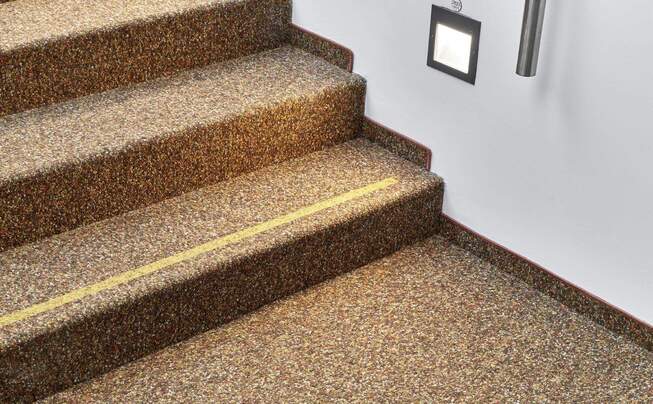
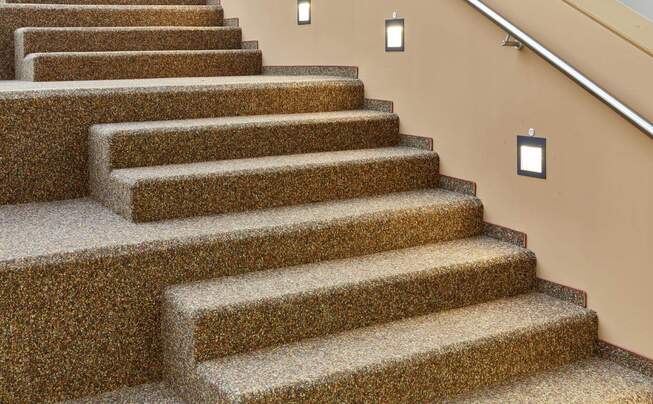
The steps are also covered with Kugelgarn®. The directionless surface of Kugelgarn® gives the rounded edges of the steps a uniform and seamless look thanks to the perfect craftsmanship. As if cast from a mould.
To enhance the homely impression, for the first time we had the skirting boards made not from wood but also from Kugelgarn Impression® malawi, with a chain moulding as the upper finish.
After consultation with the accident insurance fund, we were able to limit the safety measures on the seating steps to handrails on the walls, thus maintaining the uninterrupted, spacious impression of the room. To achieve this, we had contrasting strips from the Fabromont Graffiti collection in the high-contrast colour ginster incorporated as inlays into the direction-free surface of the malawi on the first and last steps of the walking and seating steps.
Fabromont: School buildings are subject to particularly heavy wear and tear – how does Kugelgarn® prove itself in daily use, e.g. in terms of robustness and maintenance, and what role did sustainability play in your choice of material?
Roland Schulz: This is now the first of our numerous school construction projects in which the school authority has not insisted on installing linoleum flooring, which is still the preferred choice here in the north.
The building authority was convinced by the considerable advantages of Kugelgarn® flooring. The arguments of durability and associated longevity, fire behaviour, high-quality appearance and, above all, sound absorption scored highly.
Kugelgarn® is also interesting because of the follow-up costs for maintenance cleaning. More than 15 years ago, we had Kugelgarn® flooring installed in our own residential and commercial building, which had undergone a complete renovation just a few years earlier, with a visually appealing mastic asphalt screed and a black trowelled surface. We then noticed that the cleaning frequency could be significantly reduced compared to hard floor surfaces that had to be cleaned daily with water and cleaning agents. All we needed to purchase was a brush vacuum cleaner.
I consider durability and low cleaning requirements to be key aspects in terms of sustainability.
Fabromont: Do you see the use of textile floor coverings such as Kugelgarn® as a forward-looking concept for other educational buildings? What recommendations would you give to other builders or architects for school construction?
Roland Schulz: The advantages of using textile floor coverings such as Kugelgarn® are obvious and well known to committed architects. In school construction, acoustics are an essential criterion for optimal conditions for teachers and learners. As a supplement to acoustic ceilings, textile floor coverings offer significant advantages beyond just additional sound absorption. Kugelgarn® is also a literally quiet covering that is characterised by its pleasant feel when walking on its soft surface, offering a
high level of walking comfort.
However, school authorities as building contractors often fail to understand that although a high-quality product such as Kugelgarn® is slightly more expensive to purchase than simple floor coverings such as linoleum or needle felt, it also offers a longer service life without any change in appearance.
In terms of life cycle costs, I would definitely rate this product as economical due to its long service life compared to other floor coverings and taking into account the lower follow-up costs, and I would recommend it without reservation for installation. Whether for office buildings or school buildings.
Fabromont: What does this project mean to you personally – and what are you particularly proud of?
Roland Schulz: I think that school buildings are more than just functional structures for teaching. School buildings are an expression of both our building culture and our attitude towards education policy. In addition to the family home, schools have the task of laying the foundation for education and careers and thus for social integration and recognition. A key prerequisite for this is always a well-designed school building that is a pleasant place to learn.
In Neukloster, it has been understood that one of the central tasks of our society is to create the structural, i.e. spatial and architectural, conditions for contemporary and sustainable education and training.
For the construction work on the regional school, phases 1 to 3, this meant adapting the building, which was completed in 1874 as the ‘New School Building’, to new educational models and the associated tasks. With the necessary new extension as the second construction phase, we have succeeded in creating excellent conditions for motivated and successful teaching and learning at this school location.
I am particularly proud that we were able to come in around 4% under budget in times like these and that we succeeded in handing over the new extension building as the second construction phase on schedule for the start of the new school year 2025/26 on 4 September 2025 for use by the regional school.
With the third construction phase, the partial renovation of the existing building, we plan to transfer the quality standard of this new extension to the school building from 1876 in order to create a school location that is homogeneous and of high quality overall. Construction is currently scheduled to begin in the summer of 2026.
Both Fabromont's Kugelgarn Impression® malawi flooring and Italian terrazzo tiles will be used again.